Yes, Maybe, Never! (Correspondence, Part 5)
This is Part 5 of our series on correspondence between Landis and the USADA. In Part 1, we heard USADA wasn't providing any more than Landis already had; In Part 2, we learned what Landis had been asking for. In Part 3, we saw an abortive attempt to turn this into a one-step proceeding, with a single hearing directly before CAS, which appears to have been rejected by USADA, even though it was their idea. In part 4, we discovered USADA's reaction to the idea of public hearings, and how that probably killed the idea of a single-CAS hearing idea.
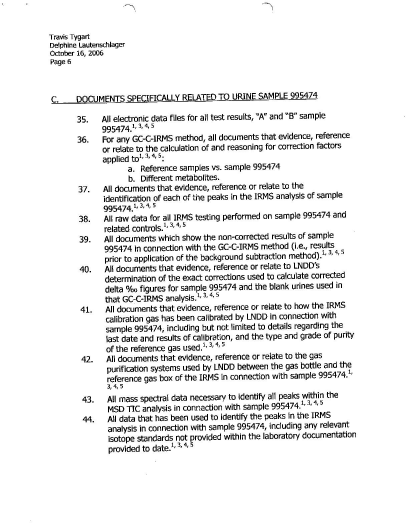
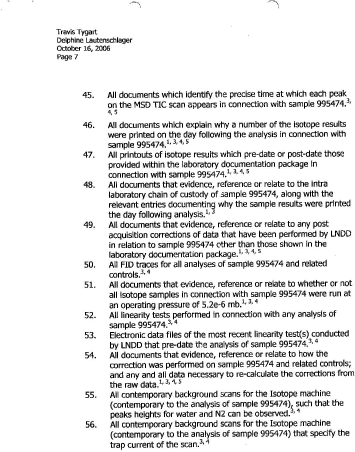
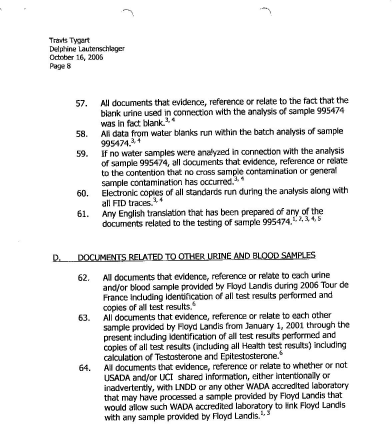
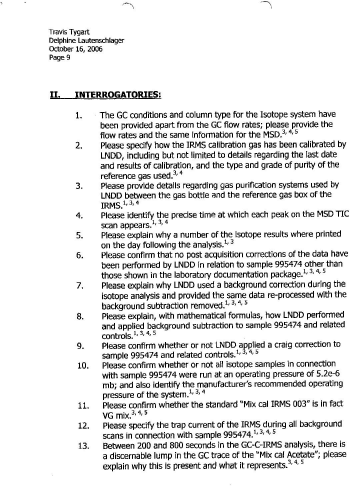
The last topic of correspondence is the data from the other tests performed at the tour...
[more]
[continuation]
The WADA Results Management Guidelines say7.4 The athlete is also entitled to copies of all documentation relevant to the assertion that there has been an Anti-Doping Rule Violation, and the ADO shall provide this to the Athlete or his/her representative upon request.
Click on a page image to see the original document. Way back on 7-Aug, USADA sends a letter to the UCI requesting the Lab Pack for the Stage 17 tests, and, because there were TE violations in the original report, data that would be needed for a longitudinal study, being all the other test results. Landis was copied on this letter, because USADA presumably believed he was a party with a need and a right to know.
On 31-Aug, Landis receives the lab documentation package, and it does not contain the longitudinal data that USADA asked the UCI for on 7-Aug. Landis's submission to the ADRB sent on 12-Sep says that since there has been no longitudinal data supplied, the TE violation cannot be considered an AAF. A month later on 9-Oct, Landis wonders if the other data has been sent to USADA, and asks for it to be sent.
On 12-Oct, Landis releases documents and the Arnie Baker slide show.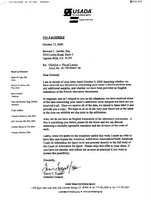 On 13-Oct, USADA tells Landis it has some of the material, and says it will send it when all of it appears and they can assign Bates numbers to the lot. The key paragraph reads (emphasis added),
In response, and as I relayed to you on the telephone, we have received some of the data concerning your client's additional urine samples but have not yet received it all. Once we receive all of the data, we intend to bates label it and provide you a copy. We hope to do so in the very near future but at the latest at the time our exhibits are due prior to the arbitration.
The only possible equivocation there is the phrase, "we intend", but there is no suggestion of a reason they won't or can't be sent. If there were a rule preventing it, there ought to be mention. The main qualification is about the timing, where they reserve the right to wait until the last possible moment.
The letter also provides the written offer for the single CAS hearing described in part 4.
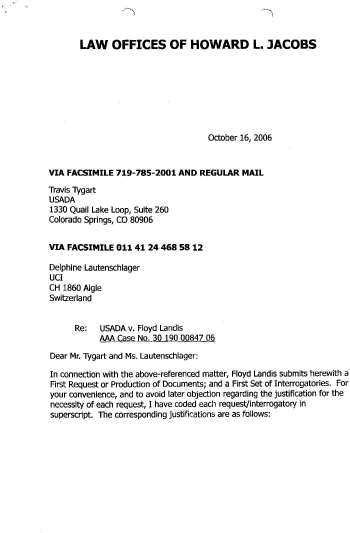
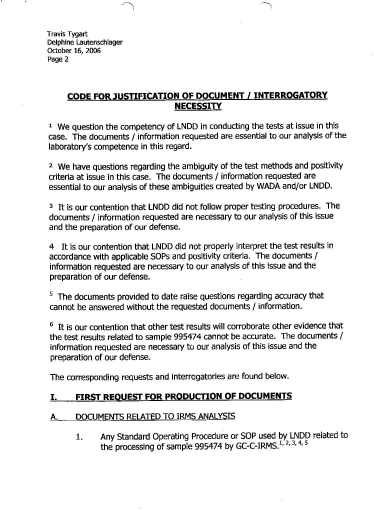
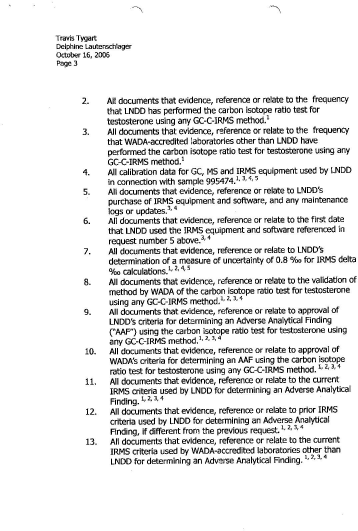
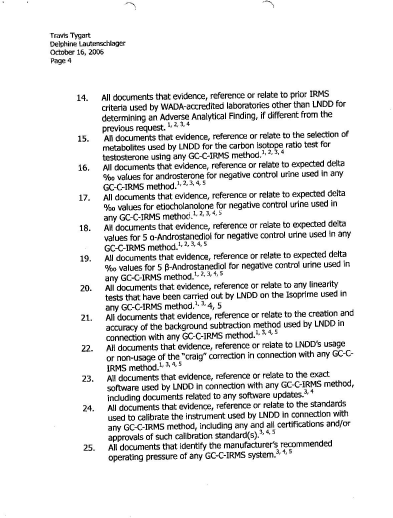
On 16-Oct, Landis sends his document request, covered in Part 2, and his conditions for single CAS hearing, covered in part 3.
On 17-Oct, USADA and Landis send letters to USADA about public hearing, covered in Part 4.
On 23-Oct, Landis sends his public hearing proposal, covered in part 4. On 26-Oct, Landis asks again for the longitudinal data, saying there is no reason to wait on the Bates stamping, and suggests delays may become prejudicial to the case.
 1-Nov, USADA says wait for it, but adds a new caveat not present in the 13-Oct letter. Here it says they will deliver "a copy of the documents we intend to rely on...at the very latest when our exhibits are due."
This leaves open the position that if they don't rely on it, then they won't produce it (voluntarily).
Comment: this has been described as "cherry picking" the evidence. They decide what they want to pursue, and don't produce anything else. 1-Nov, Landis says waiting is prejudicial. The could have asked UCI for the documents themselves, but (a) USADA has already done so on 9-Aug. (b) If TE is used, you'll have to produce it anyway; (c) producing at the last minute precludes Landis from doing any followup.
Please send now.
Comment: Did Jacobs shoot himself in the foot by not asking the UCI for the documents when he may have had the chance early on?
1-Nov, USADA says no single CAS hearing, discussed in part 4.
3-Nov, USADA says no more documents at all, and doesn't produce the longitudinal data known to be in its possession.
This is where came in at Part 1. Let's look at what they say again:We will not be providing any documents or other information in response to your requests. As you should know, the rules applicable to this proceeding establish the set of document that are provided by the laboratories when a sample tests positive. After studying your request and those rules, every request you make appears to seek documents or information not called for by the rules.
USADA appears to be hiding by the rule in the ISL that says what the laboratory must provide. It does not cite a rule that limits what USADA may provide. It is choosing not to provide documents known to be in its possession that it had been willing to send on 13-Oct.
It also says UCI is not a party, so Landis can't drag them in - though in the 4-Oct letter to the AAA (part 4), they said,By copy of this letter, we are also advising the Union Cycliste Internationale ("UCI") and WADA that they have a right to participate in the hearing either as a party or as an observer.
Summary
This raises questions:
The simplest explanation is that there aren't clear rules one way or the other for what USADA should produce when, and USADA has taken advantage of the discretion at Landis's expense. The guidelines quoted at the top may not have force; there can be quibbling about what "relevant" means, and whether they say exactly when things need to be provided.
When USADA were hoping for a single CAS hearing, they could freely dangle the carrots. When they decided they were not going to have a public CAS hearing, they could say, "No" to things they had previously proffered, and all other data. There are no consequences for this action that matter to USADA. Should the arbitrators rule in favor of Landis, it has merely cost time, which Landis has less of than USADA.
It's likely the arbitrators will order production of the longitudinal data, and many of the other things in the document request. USADA knows this, but they are withholding and denying it anyway. It's the game play of a litigator looking for a Win!, not that of a responsible party seeking to promote "Fair Play."
A few days ago, a commentator on the series said something we picked up in a Quote of the Day, which we'll repeat because of its pertinence.If USADA is playing to "win" rather than find out whether you doped or not, then they are failing in their mission and not advancing toward the goal of clean competition.
The intent of the guidelines is that the ADO should provide the data when requested. USADA hasn't. It may be within a narrow interpretation of the rules to deny, but how does that fall in with the spirit of "Fair Play?"
If you think USADA is faultless, or that Landis is a dirty-rat bastard playing lawyer tricks, please post comments or send mail, and we will report the arguments, as always.
Thanks for taking the time to read this lengthy series.
TBV
This concludes our look at correspondence between USADA and Landis. Now that it is all done, you may wish to look at the TIMELINE that brings it all together.
Back to part 4,
All documents presented in this series can be found in the collection at archive.org.
[end]